
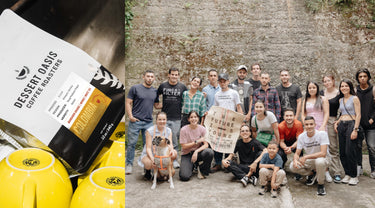
A closer look at the people, innovation, and challenges shaping the future of coffee in Colombia.
You might have had the chance to try one of our featured coffees on our pour-over menu, Colombia Young Producers | Chiroso Washed, by this time! You may have even had a phenomenal experience with the cup; including tasting notes of mango, white tea, and mandarin orange — what’s not to love?
But did you know about the innovation behind the variety of this coffee? How about the story about the producers? Or where this coffee comes from and the history of the land? We're going to spill all the tea — or coffee — behind this very exceptional cup, featuring a short interview with Michael Dowdell, Sales Manager at Unblended Coffee Imports, where he answers all of your pressing questions about this remarkable coffee and the Young Producers Program.
Spend a few minutes with us as we touch on the future of coffee growing right in Colombia and the way climate change is actively impacting your daily morning cup.
But first… the details:

Growing Region
This coffee comes to DOCR through our friends at Unblended, and the wonderful Young Producers in Antioquia, Colombia! Antioquia is one of Colombia’s 32 Departments, located in the northwestern portion of the country. It also is part of the historic Eje Cafetero, or Coffee Triangle — a geographic, cultural, and economic coffee producing region of the country.
The region is well known for its spring-like temperatures, and its mountainous landscape, making it the prime location to grow an abundance of coffee. Colombia is currently ranked as the third-largest coffee producer in the world, producing about 7% of the global coffee supply.
Historically, Antioquia was defined by volume, and was actually the largest producer of coffee in Colombia in the late 1900s, producing most of the green coffee output of the country itself! The region still produces a lot of coffee, but is now more defined by its smallholder farms and high-scoring Arabica specialty coffee. Today, Antioquia is the second-largest coffee growing department in Colombia after Hulia.
The Chiroso Variety
This coffee is extra special due to the variety, or the type of coffee plant it comes from: Chiroso. Discovered in Antioquia, the variety’s true origins are unknown, but it is most commonly produced in the high-altitude mountains of Urrao and Caicedo in Antioquia, Colombia.
Caicedo is actually the exact city where this specific coffee, Colombia Young Producers, was grown as well. If you see the term Chiroso used on a bag in the future, just know that that coffee variety was discovered in The Coffee Triangle of Colombia!
The term itself, Chiroso, translates to ‘elongated’, referring to the slightly oblong shape of the cherry. Originally, producers thought it might have been a mutation of the Cattura variety due to similar leaf's shape + size, and had referred to it as Cattura Chiroso — Cattura with an elongated cherry — but recent studies have shown its genetic origins are more closely linked with Ethiopian coffee varieties.
As a variety stemming from Ethiopian Landrace varieties, you can imagine the cup has similar qualities: complex sweetness and acidity. In addition, most Chiroso coffees also have a signature florality with a syrupy mouthfeel.
The variety first won the Cup of Excellence award in 2014, when producer Doña Carmen Montoya took this rare variety to the competition. Afterwards, the variety quickly spread across Antioquia, and has earned a reputation for its quality globally.
The Washed Process
This Chiroso was carefully processed using a unique version of the Washed (or wet) method of processing.
Usually during the Washed process, as coffee cherries are harvested and picked, they immediately remove the fruit from the coffee seeds (coffee beans) using a depulper. However, with this Chiroso, partners Elkin Diosa and Danilo Flórez decided to use an innovative approach to the washed process — they allowed the coffee seeds to ferment for 48 hours with the cherry intact, before de-pulping and continuing with the next step of drying the coffee seeds (coffee beans).
The final result is a sweet and floral cup with subtle tropical fruit notes, beautifully balanced by a smooth caramel sweetness. Our team loves how this process allows the flavor of this rare variety to shine, highlighting the complex florality this coffee possesses.

Unblended and The Young Producers
Coming to DOCR by way of our friends over at Unblended, a producer/exporter group that works directly with farmers in Colombia, it marks the future of specialty coffee. Unblended's philosophy is simple: “The future is young.” Meaning that the future of the specialty coffee industry will be decided by young coffee producers who will carry on the torch of harvesting, farming, and innovation.
This philosophy is especially critical at this moment as the industry shows increasing amounts of previous generations of coffee farmers aging out of coffee producing and inevitably retiring, all while younger folks search for work elsewhere in more lucrative industries.

The Mission
Unblended’s mission strives to help the future of young coffee growers.
The Young Producer Program empowers emerging coffee growers to build and market their own brands intentionally. By guiding them through tailored modules on branding, production, and sales, the program helps participants create differentiated products and connect with U.S. roasters, driving both brand recognition and profitability.
These young, talented producers — with the mentorship and support that Unblended provides for their group — are innovating and creating flavor profiles through their coffees that are inspiring the industry. They showcase the potential in coffee producing; from experimental processing to the future of coffee growing and what is yet to be discovered.
The Young Producer Program is not just coffee production, but an investment in the future of specialty coffee, and an exploration of the possibilities in each cup, in addition to the future of coffee in general.

The Future of Coffee Growing in Colombia
Combined with the decreasing amount of young producers in the coffee industry, another critical impact on the industry, especially recently in Colombia, has been climate change.
Changes in global climate and average temperatures have undoubtedly already disrupted the coffee supply chain all over the world. Coffee plants are very sensitive to growing conditions, and usually prefer distinct wet and dry seasons, in addition to a temperate climate overall.
For nearly three years straight, growing regions in Colombia have experienced near constant rainfall. Reports from farmers in the Eje Cafetero region note that the rain has made coffee trees lower yielding and harvest seasons elongated, making it difficult to assemble the necessary labor over several months, instead of the typical few weeks.
The worst part is that farmers are usually the ones bearing the worst of these effects. Lower-yielding coffee trees means less crops, which means less income overall. As temperatures continue to rise, coffee trees will need to be planted at higher elevations, moving current infrastructure for farms with it. Not only is this incredibly costly, but higher elevations are also more labor intensive for farmers.
Colombia is the 3rd largest producer of coffee in the world, with suitable growing land that is expected to shrink by 50% by 2050. Considerable science and experimentation has been done to help mitigate the climate crisis, such as:
- Variety research and crossbreeding
- Increasing shade and cover using foliage
-
Cutting water usage and reusing coffee production byproducts
Recent News
However, some uncontrollable damage may be hard to come back from. On August 11th, 2026, a magnitude 7.4 earthquake hit the western part of Colombia, resulting in 300 deaths and leaving over 4,000 people injured in its wake. The earthquake was the largest in the country since 2016, and instantly became a devastating humanitarian crisis.
Damage spanned across houses, schools, and hospitals, in addition to damaging countless coffee farms and infrastructure — completely halting coffee exports at the time due to a landslide over the main road used for coffee exports. This natural disaster heavily impacted growing regions: Risaralda, Valle del Cauca, Caldas, Antioquia, Chocó, and Quindío.
There is only so much mitigation coffee producing countries can do to prevent the loss of crops, especially when we see such large-scale catastrophic natural events like these. Farmers in Colombia are still repairing their farms and communities are still rebuilding. As roasters and coffee lovers, we need to be doing our best to contribute and support the entire supply chain. Always.
Check out our interview with Michael of Unblended below for how we can do our best to help support smallholder coffee farmers and support programs like the Young Producer Program.
On the Young Producer Program and Coffee in Colombia — with Michael Dowdell of Unblended
Emma: In your words, how would you describe the Young Producer Program and Unblended’s relationship with them?
Michael: The Young Producers Program, or YCA (Young Coffee Alliance), is a program that connects young producers, roasters and mentors together to make coffee farming exciting and viable for the next generation. Every producer has a different vision, and we want to understand that from the beginning of our relationship.
We start each relationship by understanding where the producer is now and what they want to achieve, then help connect them with the right mentors, resources, and roasters who can support that path.
As we found through time, many of the younger producers specifically want to become brands. Meaning, they want to see their families names highlighted on bags, featured in competitions, and create a name for themselves in the industry. Our end goal is to get them there and help them pursue their dreams!

Emma: How did the Young Producers start? Was there a catalyst or a specific event that called for the need of this program?
Michael: Unblended was Lucas’ master thesis back in 2019. It started as a marketing agency for coffee shops and coffee producers. Over time, it became clear that the producers that gravitated more towards that idea were young producers who were already connected through social media to the worldwide Specialty Coffee culture.
Then the next question became how do we help develop these young producers inheriting traditional farms into worldwide brands, and the incubator-type model started taking shape. Then we introduced mentors into the programs and lastly we introduced the Development Camps.
Emma: What were the signs that the Young Producers of Colombia could find opportunities for growth better together instead of separately?
Michael: Just like anything in life, especially in business, many minds are better than one. For younger producers looking to enter a commodity industry that is a lot of work, growth typically comes from sharing ideas, having a community to be able to help, and collaborative efforts.
Also, farms could be quite far from where the coffee is processed and milled. Without collaboration from other producers, it could be tough to get your coffee off of the farm, let alone exported to another country.
Emma: How do you find that the Young Producers program has positively impacted the lives of producers in Colombia?
Michael: There is still a lot to be done, but the main thing I can say is that every producer we work with is motivated. They are active in the group chats, they show up to the producer meetups and events and they have a clearer view of the future.
In terms of demonstrable economic impact, the young producers that have been able to achieve “brand status” have been more profitable and have had more stability as they have customers that buy their coffees multiple times per year.
Emma: What can coffee consumers/roasters do more of to help support programs like the Young Producers?
Michael: From the consumer end, I think it takes understanding that when you purchase coffees from Young Producers, you are literally supporting the future of coffee.
Every picture you take of a bag and post on social media helps that producer's name get out. A step further would be following the producer on social media, if they have one, and supporting their brand. At the end of the day, the Young Producers that grow the most are the ones that become well known across the world.
It's the roaster’s job to tell this story to their consumers. Using the photos and content from us is one thing, but taking it a step further and hosting events, including info cards with each coffee, a shoutout to the producer on social media, etc., all helps make the connection more visible to the consumer.
Emma: For a lot of coffee producers, the C market heavily determines their income and quality of life, though C market prices can be quite volatile. How do programs like the Young Producers help provide support for young coffee producers and make coffee growing a viable career?
Michael: The first thing the Young Producers Program does is build a system for the young producers to be able to sell through their main washed offerings at volume in our Recruitment Lot, over C market price.
Not only are they making more than if they were to sell to the Colombian Federation, however, they are building a funnel to be able to create a foundational washed [coffee], as well as frequency to be able to sell more unique varietals and processed coffees. This in the long run helps them grow a sustainable portfolio, while continuing to have access to collaborate and innovate.
Secondly, once these producers have built a brand they gain price stability - meaning their price is a result of a negotiation with the roaster and not a consequence of the C-Market. Also, once they become a brand we help them diversify their portfolio, which means they can have a variety of different coffee profiles sold at different prices from their farm. These two things result in higher and more predictable profitability.
Emma: What was a moment or experience that made your work with the Young Producers feel inspiring?
Michael: Oh this one is easy. It's got to be what I experienced during my first trip to Colombia! In October 2023, I took a trip to Colombia to go to PRF (Producer Roaster Forum). Lucas and the Unblended crew were nice enough to host us. One of the first things we did was go up to Andes, Antioquia, to Cabresto Coffee.
It was at this cafe + roastery where I witnessed Andres Cardona and Carolina Ramirez (both producers whose coffees I’ve enjoyed before meeting them in cafes around Atlanta), graduate from mentees to Mentors. I felt the passion, the collaboration, and the hard work that these producers put into their product, and to see it pay off in this way was incredible. Not only was this moment inspiring, it is the reason I am here today!
Emma: Have you received any recent communication from producers in Colombia after the earthquake? Is everyone okay and how has this catastrophic event impacted their lives?
Michael: Overall the earthquake was devastating, affecting millions of people around Colombia. People lost their homes, loved ones, businesses and more.
While many people have experienced themselves, or know someone affected by this earthquake, we are extremely grateful to say that none of our producer partners were greatly affected. Some experienced minor damage at their farms, but no one was injured or lost a loved one.
What was impacted was the Buenaventura port, where most coffee is shipped out of. This has had many producers rerouting to the Port of Cartagena, and luckily for the producers we work with we made this change a while ago.
Emma: What can the coffee industry do to help support the impacted coffee producers?
Michael: These kinds of catastrophic events can happen at any time, unknowingly and random. For that reason we will not be able to offer much preventative help, other than some charitable donations to help construct areas and resources for people to go during a crisis.
I would say continue to support producers by purchasing their coffees, telling their stories, and asking directly if there is anything we can do to help.
Photos provided by Unblended.
——
Sources & Further Reading
-
Antioquia Coffee: Colombia’s Largest Coffee Department — Podium Coffee Club
-
CBGC 1.02 Antioquia — Barista Hustle, September 22, 2022
-
Lessons from Colombia’s Sustainable Coffee Sector — Carmen Caballero, World Economic Forum, June 6, 2025
-
Observing the Effects of Climate Change in Colombia — Lydia Corran, Wonderstate Coffee, January 17, 2024
-
Colombia Earthquake Disrupts Global Coffee Exports — Tobias Pearce, World Coffee Portal, August 13, 2026
-
Chiroso: Colombia’s Competition Standout — Hilde Vanderhenst, Efico, February 21, 2026
-
Chiroso: An Up-and-Coming Competition Coffee? — Thomas Wensma, Perfect Daily Grind, February 7, 2024
——

ABOUT THE WRITER: Emma LaVoie is Head of Education + Curriculum for Dessert Oasis Coffee Roasters. She's the brains behind this blog and lit a fire under our team to follow suit. You can almost always find Emma reading a book with a coffee in hand. If you're interested in reaching out to Emma, shoot her an email: emma@dessertoasiscoffee.com. She'd be happy to geek out over coffee with you. (Seriously, don't hesitate to reach out — she'll love it.)